

Kauser News Agency | Special Investigation | October 16, 2026
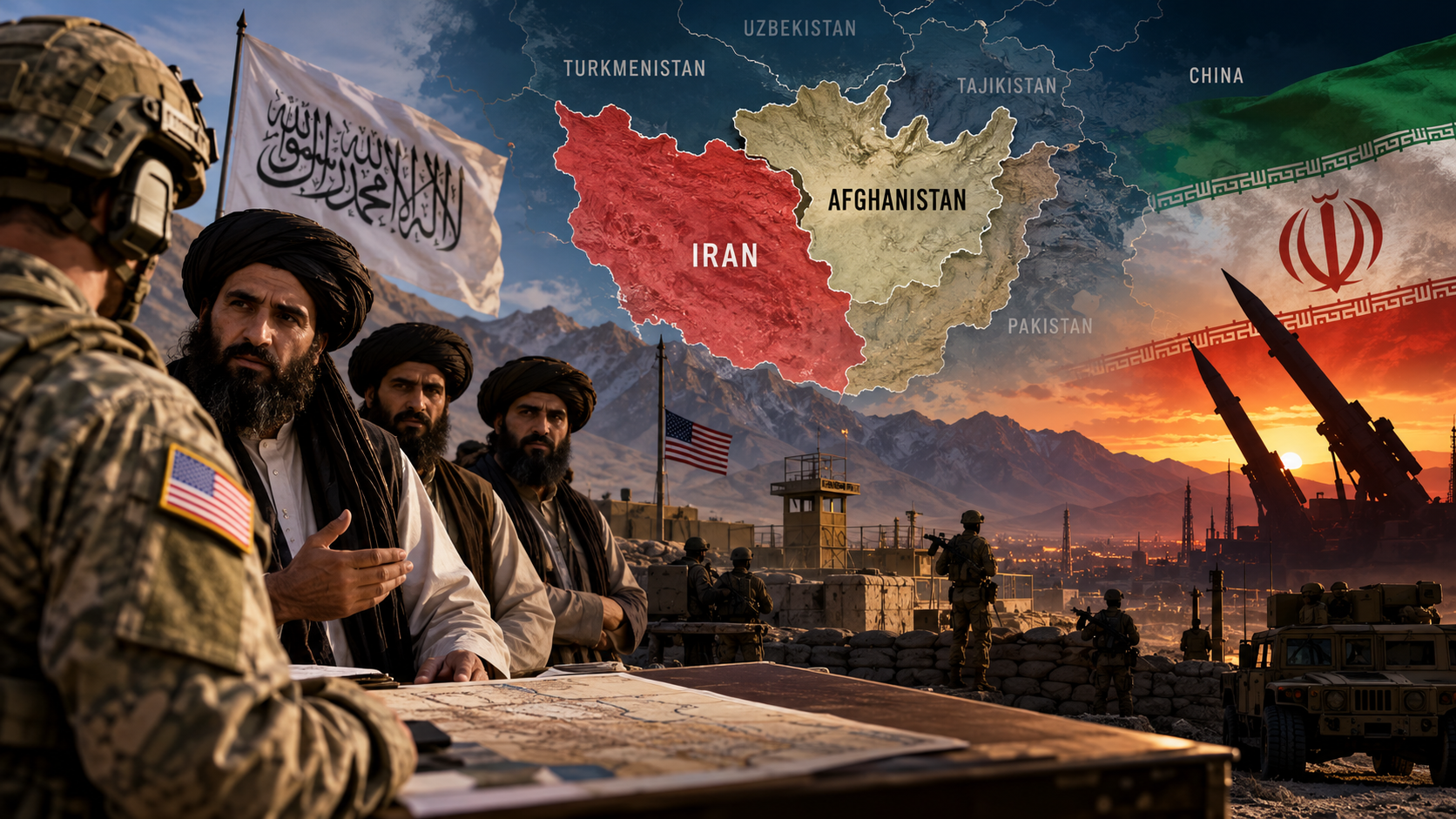
Scenario analysis: No independently verified evidence establishes that the United States has requested Taliban assistance for attacks on Iran. The accompanying AI-generated image is a fictional illustration, not a photograph of actual cooperation.
If Washington ever asked Afghanistan’s Taliban authorities to assist military operations against Iran, the consequences would depend on what support was requested. Sharing intelligence, providing logistical access, permitting American forces to operate from Afghan territory and joining combat operations are four distinct possibilities. None should be mistaken for a confirmed agreement.
The first decision: what kind of cooperation?
Information-sharing could involve discussions about threats and border security without creating an American military presence. Allowing the United States to operate from Afghan territory would be far more consequential. Direct Taliban participation in attacks would introduce an additional risk of Afghanistan being treated as a party to hostilities. Each step would require its own evidence before journalists could report it as fact.
Iran’s possible response
Iran shares a long border with Afghanistan and is an important route for Afghan trade and fuel. Tehran might respond to perceived Afghan involvement by increasing border security, restricting commercial activity or taking other diplomatic and military measures. The extent of any response would be uncertain, but Afghan border communities, transport companies and households could bear the costs of disruption.
What the Taliban might seek
The Taliban might view a hypothetical request as leverage to seek diplomatic engagement, economic concessions, sanctions relief or security assurances. Those outcomes could not be guaranteed by any informal understanding. The movement’s history of fighting American forces could also complicate internal acceptance of an arrangement with Washington.
Russia, China and the wider region
Russia and China have established relationships with Taliban-controlled Afghanistan. A renewed U.S. military footprint could raise questions for both capitals about regional security, influence and the intentions of Washington. Their actual reactions would depend on the scale, duration and purpose of any cooperation, and should not be presumed in advance.
Economic and humanitarian exposure
Afghanistan’s import-dependent economy is vulnerable to transport delays, higher energy prices and interrupted border trade. A regional escalation could also complicate humanitarian deliveries and civilian movement. The people most affected might have little influence over the decisions that triggered the disruption.
The international-law question
Even if Afghan authorities invited foreign forces onto Afghan territory, that invitation would not by itself establish a lawful basis for attacking Iran. Any use of force would require a separate assessment under the United Nations Charter and applicable international law, including the rules protecting civilians during armed conflict.
What investigators should verify
Any credible report of such an arrangement would require corroborated evidence: attributable official statements, authenticated documents, independently verified movements or facilities, and responses from the governments concerned. Anonymous claims or speculative images alone would not establish that a request, agreement or operation occurred.
Assessment
A limited diplomatic contact and an agreement to host military attacks would carry dramatically different risks. The latter could expose Afghanistan to retaliation, economic losses and geopolitical pressure without guaranteeing diplomatic benefits. For now, the proposition remains a hypothetical scenario, not a verified U.S.–Taliban plan.

Leave a Reply