

Kauser News Agency | Investigative Analysis | October 16, 2026
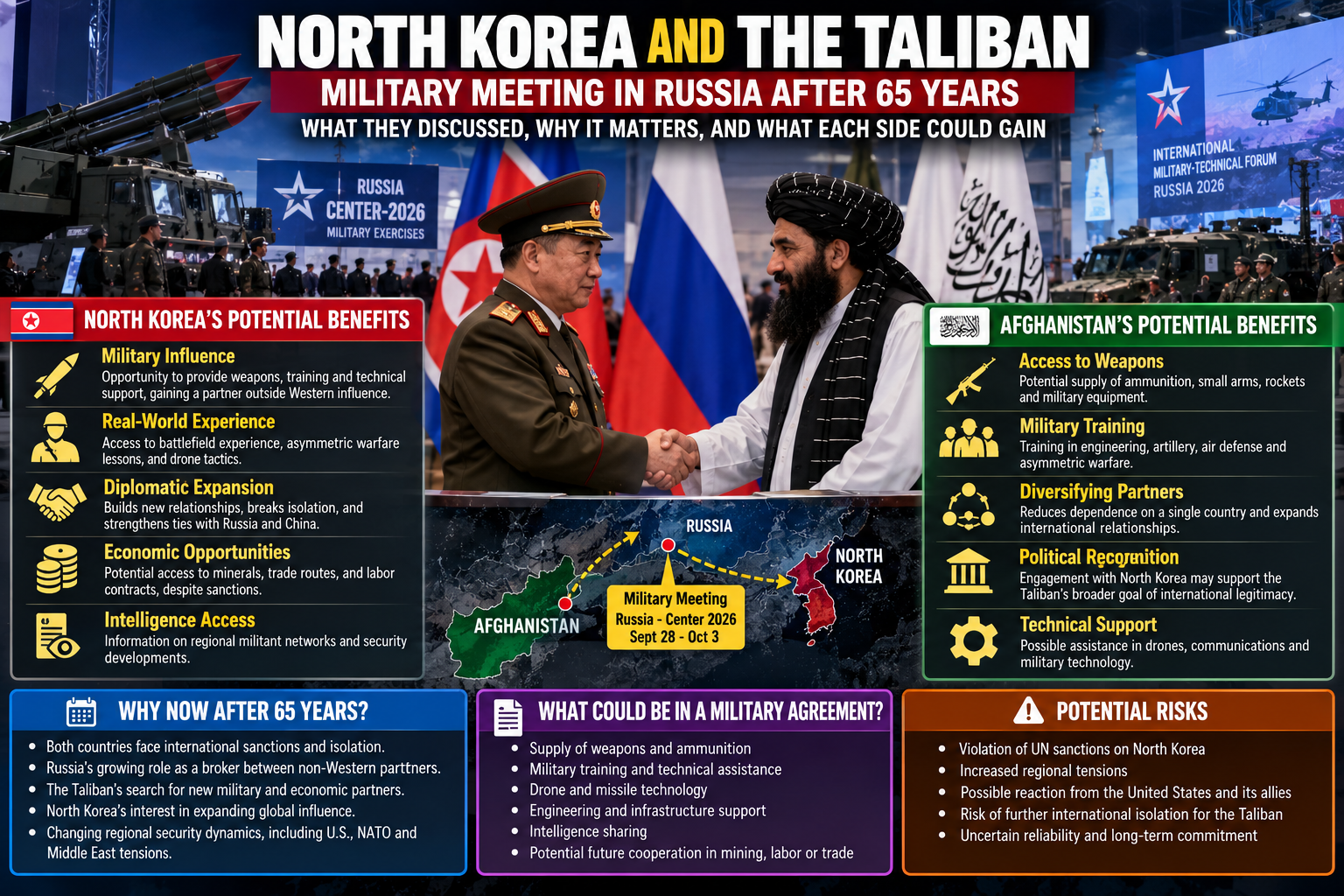
A meeting between a Taliban military commander and a North Korean military attaché at Russia’s Center-2026 exercises has opened a new line of inquiry into Pyongyang’s possible interests in Afghanistan. The contact is documented. A military agreement, arms transfer or intelligence-sharing arrangement is not.
The meeting in Russia
Russia hosted Center-2026 military exercises from September 28 to October 3, with foreign delegations attending as participants or observers. Reporting by NK News identified North Korean military attaché Ro Ki Chol meeting Mawlawi Nasibullah Madani, head of the Taliban’s Abdullah bin Masoud Joint Combat Training Command, at an associated arms exhibition. Afghanistan’s Defence Ministry released imagery of the encounter and described discussions with multiple foreign military representatives about cooperation, training and exchange of experience.
The setting matters: the meeting took place at Russian-hosted exercises, not at a Chinese event. Other countries’ representatives were present, but their attendance does not prove coordinated negotiations.
What North Korea might seek
Pyongyang may view contacts with Afghanistan’s Taliban authorities as a low-cost way to widen diplomatic and military relationships outside its usual partners. Discussions of training and professional education could help it learn about Afghan military institutions and establish channels for future contact. These are potential motivations, not confirmed objectives stated by North Korean officials.
Afghanistan also occupies a strategically important location between Central and South Asia. North Korean officials may be interested in regional security developments, but no verified source reviewed for this article establishes a Taliban–North Korean intelligence agreement.
Why Russia matters
Russia’s role as host gave officials from otherwise distant or diplomatically isolated governments an opportunity to meet. Moscow recognized the Taliban administration in 2025 and has pursued broader security and diplomatic engagement. The exercise illustrates how Russian-led events can facilitate contacts without proving that Russia brokered a specific bilateral agreement.
Sanctions and the limits of cooperation
North Korea is subject to extensive United Nations Security Council sanctions, including restrictions on arms-related transactions. Any future claims of weapons sales, technical assistance or training arrangements must be assessed against the relevant sanctions and verified independently. A handshake at a weapons exhibition is not evidence of an arms sale.
What remains unknown
The publicly available accounts do not establish whether the officials signed documents, agreed to follow-up visits, exchanged intelligence or discussed weapons procurement. Kauser News would need official records, corroborated firsthand accounts or documented subsequent actions before making those claims.
Assessment: The Center-2026 meeting demonstrates a direct North Korean–Taliban military contact in a Russian setting. It warrants scrutiny as part of a wider pattern of Taliban military diplomacy, but it is too early to characterize it as an emerging military alliance.
Sources: NK News, October 5, 2026; Afghanistan International, October 6, 2026; Kyunghyang Shinmun, October 5, 2026; AtlasPress, October 3, 2026.


Leave a Reply