

Kauser News Agency | Investigation and Analysis | October 16, 2026
China’s expanding contacts with Afghanistan’s Taliban authorities are driven by security, access to natural resources and the prospect of regional trade routes. The relationship is pragmatic rather than ideological. Beijing wants influence in a neighboring country without accepting the full financial and security risks of rebuilding it.
The central question is not whether China has become an ideological ally of the Taliban. It is what each side wants from the other—and whether China’s direct engagement with Kabul changes the role of Pakistan, its long-standing regional partner.
Security comes first
China shares a short, difficult-to-cross frontier with Afghanistan in the Wakhan region. Beijing has repeatedly sought assurances that Afghan territory will not be used by militant groups threatening Chinese interests or Xinjiang. In May 2025, China’s Foreign Ministry reported assurances from Taliban Foreign Minister Amir Khan Muttaqi during talks with Wang Yi. Such statements document a diplomatic undertaking, not independent proof that the threat has disappeared.
Minerals: promise versus production
Afghanistan’s copper and other mineral deposits are an obvious attraction. The long-delayed Mes Aynak copper project illustrates both the potential and the difficulty: agreements and expressions of interest do not automatically translate into functioning mines, export revenues or broad employment. Infrastructure, security, regulatory uncertainty and archaeological concerns have all complicated development.
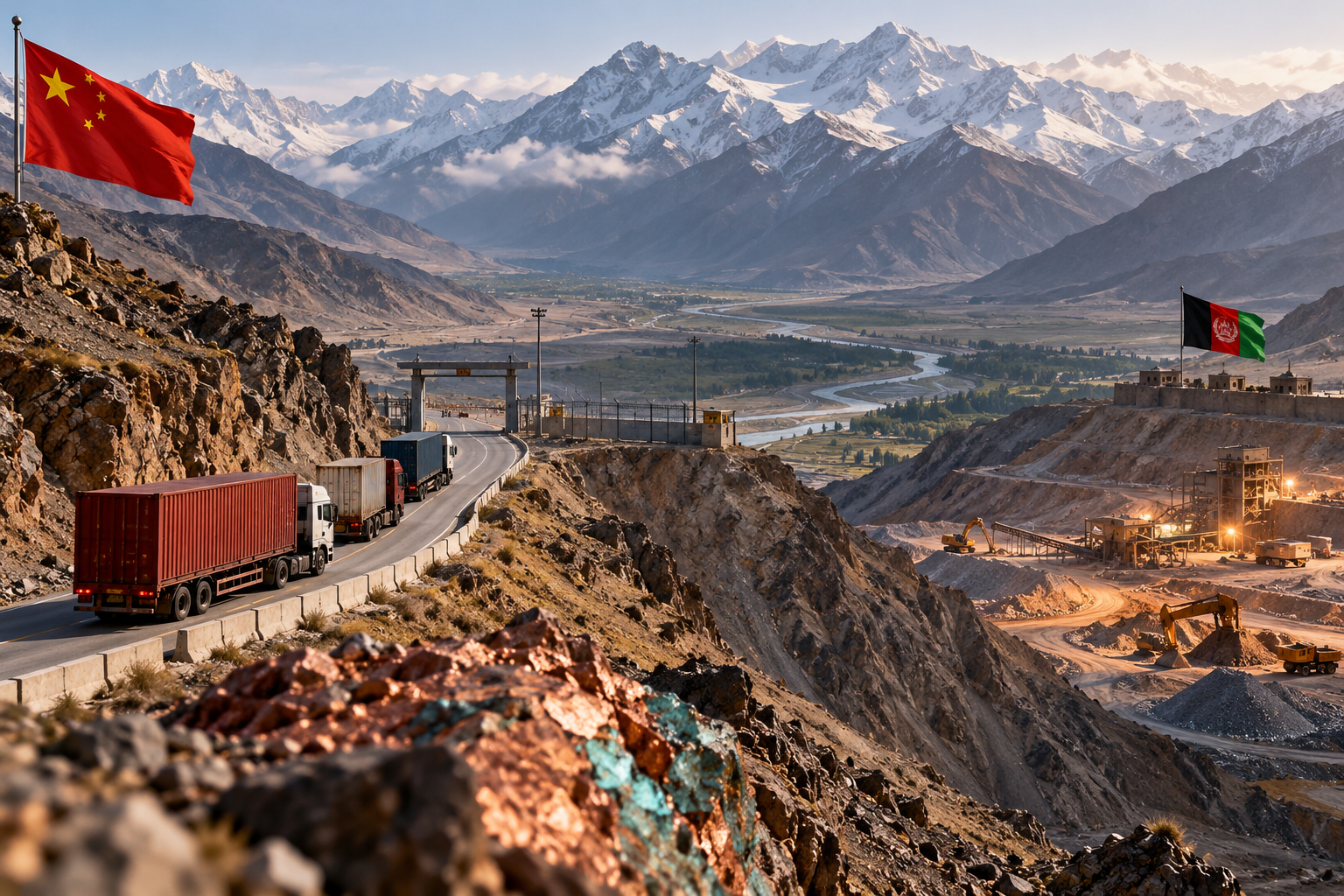
Wakhan is not yet a working China–Afghanistan trade gateway
Afghan authorities have promoted a road toward the Chinese frontier through the Wakhan Corridor. Reporting in October 2026 described progress on the Afghan side while indicating that the Chinese side was not open for regular commercial traffic. An approach road should not be confused with a functioning international customs crossing. Verified border-opening decisions, customs statistics and freight movements would be needed before claiming a new trade corridor is operating.
Diplomacy without a blank check
China has kept diplomatic channels open with the Taliban since their return to power in 2021. President Xi Jinping accepted credentials from a Taliban-appointed ambassador in January 2024; Chinese officials described the process as normal diplomatic practice rather than a separate announcement of formal recognition. The arrangement gives Beijing access and influence while allowing it to limit its commitments.
Does closer contact with Kabul mean abandoning Islamabad?
There is no verified evidence that China has decided to replace Pakistan with Taliban-controlled Afghanistan as its principal regional partner. Pakistan remains important to China through the China–Pakistan Economic Corridor, transport links and established security cooperation. Direct engagement with Kabul can instead be understood as diversification: Beijing may want more ways to protect its interests, reduce exposure to disruptions and manage tensions between its neighbors.
Pakistan’s Middle East security commitments and friction with Afghanistan make that question worth investigating. They do not, by themselves, prove a Chinese strategic break with Islamabad.
What the Taliban wants
For the Taliban administration, China offers a potential source of investment, political engagement and access to wider Asian markets. An eventual direct trade route could also reduce dependence on crossings through Pakistan. Yet announcements of proposed investment and roads are not substitutes for confirmed capital spending, completed projects and recorded exports.
Questions Kauser News will continue to examine
The next phase should compare Chinese customs records, actual investment disbursements, mining output and road construction; seek official confirmation of the status of the Wakhan crossing; and examine whether new agreements involving Tajikistan or other neighbors have Chinese participation. It should also test whether Beijing’s public security demands have produced measurable changes on the ground.
Assessment: China’s Taliban policy appears to be a cautious effort to protect security interests and preserve economic options. It is not evidence of ideological alignment or a confirmed decision to turn against Pakistan.
Sources and further reading: Chinese Foreign Ministry, May 2025 talks; Chinese Foreign Ministry briefing, January 2024; Carnegie Endowment, China’s accommodation of the Taliban; Radio Free Europe/Radio Liberty, Wakhan road reporting.
Featured image: AI-generated conceptual illustration; it does not depict a verified operating border crossing or actual mining activity.

Leave a Reply