

Kauser News Agency | Investigation and Analysis | October 16, 2026
Russia, China and Tajikistan are expanding practical engagement with Afghanistan’s Taliban authorities, but the public evidence points to overlapping national interests rather than a verified four-party intelligence alliance. Trade corridors, electricity exports, border security and diplomatic recognition are the visible pieces of a regional strategy whose private negotiations remain largely undisclosed.
What is documented—and what remains hidden
Russia became the first country to formally recognize the Taliban government in July 2025, according to Associated Press reporting. A June 2026 assessment by the Indian Council of World Affairs described a May 27 security-cooperation memorandum between Russian and Taliban officials. The complete text is not publicly available in the sources reviewed here. Its existence, as reported, cannot establish specific intelligence exchanges or covert operations.
China has pursued direct security dialogue with Taliban officials, especially concerning militant groups Beijing fears could threaten Xinjiang or Chinese nationals. Chinese Foreign Ministry accounts of meetings in 2025 record commitments to strengthen counterterrorism cooperation. Those statements establish diplomatic positions, not independently verified intelligence transfers.
Tajikistan’s immediate interests are more tangible: electricity sales to Afghanistan, cross-border commerce and the safety of its frontier. Reports of 2026 power exports and discussions about expanding transmission infrastructure demonstrate an economic relationship even as Dushanbe remains concerned about militant threats.
Follow the money and infrastructure
Afghanistan’s geographic position could link Central Asia to Iran and South Asia. Tajikistan, Afghanistan and Iran agreed in July 2026 to pursue a road-transport corridor. China was not a signatory to that arrangement. It would be inaccurate to describe the agreement as a functioning China–Afghanistan–Tajikistan trade route.
Similarly, Afghanistan’s Wakhan road project has drawn attention as a possible future link to China, but a road near the border does not prove the existence of an operational commercial crossing. The decisive evidence would be customs records, Chinese border-opening announcements and sustained freight movements.
China’s interest in Afghan mineral deposits is longstanding. Projects such as Mes Aynak show the distance between a commercial agreement and production at scale. Actual investment disbursements, extraction volumes and transport capacity are more reliable measures than political declarations.
Security: bilateral contacts are not a joint intelligence command
Russia, China and Tajikistan share concerns about ISIS-K and instability radiating from Afghanistan. That creates incentives for separate exchanges with Taliban security institutions. But there is no verified public evidence in the materials examined of a single intelligence-sharing treaty, common intelligence headquarters or joint command linking all four parties.
Regional meetings should be read carefully. The Moscow Format provides a diplomatic setting for consultations on Afghanistan, but attendance at the same meeting is not proof of a secret operational alliance. A September 2025 joint statement by China, Russia, Iran and Pakistan called for stronger counterterrorism cooperation on Afghanistan; notably, Pakistan was included, complicating claims that regional security engagement is inherently aimed at excluding Islamabad.
What each government stands to gain
Russia seeks influence in Central Asia, opportunities for trade and leverage against transnational militant threats. China prioritizes security for its western frontier, protection of citizens and investments, and potential future access to minerals and transport corridors. Tajikistan benefits from power exports and trade while seeking a quieter border. The Taliban administration seeks revenue, investment, diplomatic legitimacy and more routes to neighboring markets.
These goals can align without the governments agreeing on ideology or signing a single comprehensive pact. The same relationships can also contain friction, particularly around border security, militant organizations and the pace of infrastructure development.
Questions requiring further investigation
The strongest next steps are to obtain the full Russia–Taliban security memorandum; establish whether Chinese or Tajik officials have publicly acknowledged formal intelligence protocols; compare electricity-export figures with actual payments; inspect customs and freight data for proposed corridors; and track official procurement, project finance and construction milestones. Private negotiations cannot responsibly be described as fact without corroborating documents or credible firsthand evidence.
Kauser News assessment: A network of bilateral security and economic relationships is taking shape around Afghanistan. The public record does not yet demonstrate a coordinated four-country intelligence-and-trade agreement. The distinction matters because governments can cooperate on specific threats while pursuing separate strategic agendas.
Source documents and reporting: Indian Council of World Affairs: Russia–Taliban relations; Chinese Foreign Ministry: Afghanistan talks; China–Russia–Iran–Pakistan statement; Asia-Plus: regional transport agreement; Interfax: Tajik electricity exports; RFE/RL: Wakhan road and border trade.
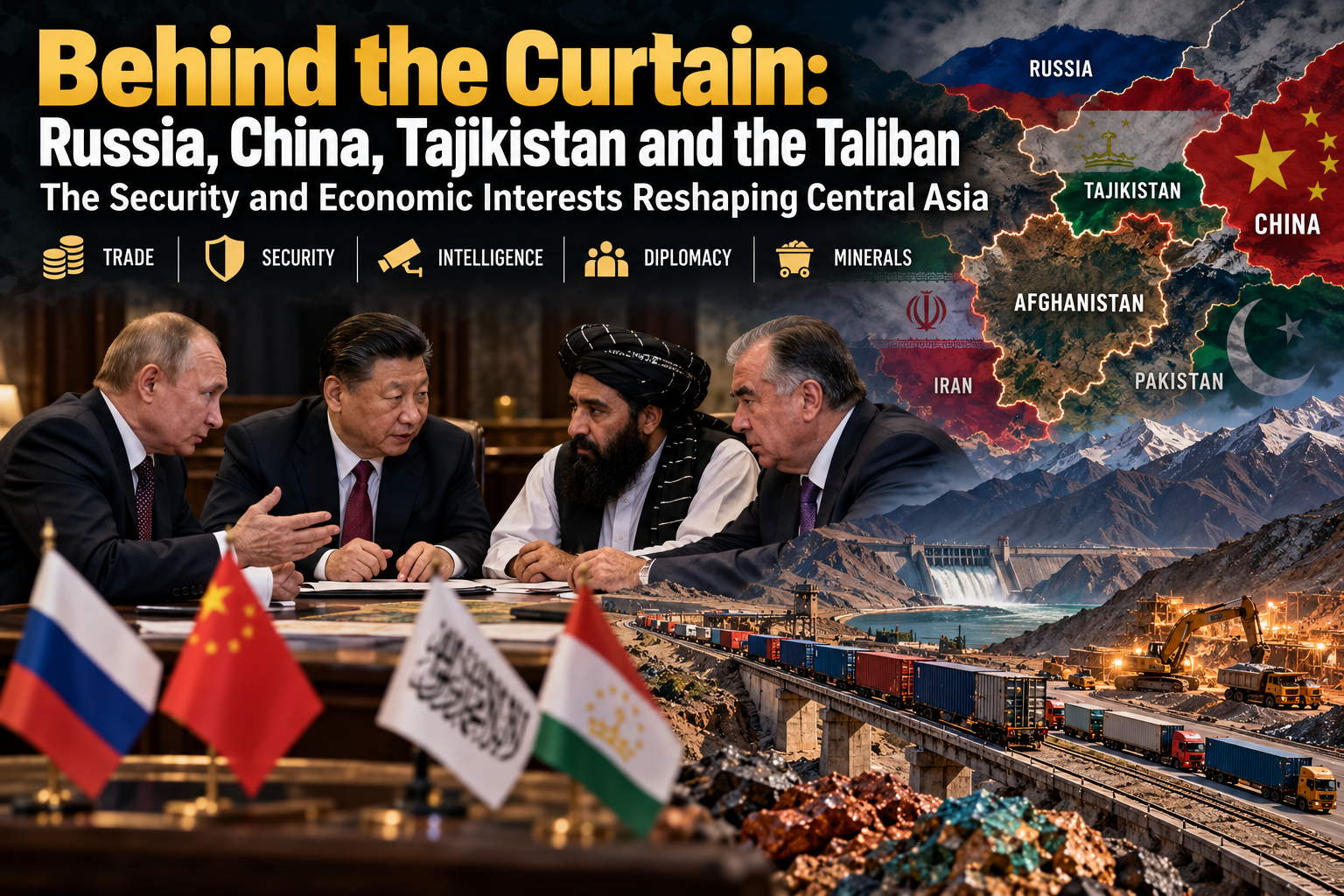
Featured image is an AI-generated editorial illustration. The meeting depicted is fictional, not evidence of a real negotiation.



Leave a Reply